Governor Proclaims Official Surfing Month in North Carolina
SURFING MONTH
2020
BY THE GOVERNOR OF THE STATE OF NORTH CAROLINA
A PROCLAMATION
WHEREAS, North Carolina was a pioneer of East Coast surfing; the April 2, 1910 edition of Colliers Weekly includes a letter from Wrightsville Beach resident Burke Haywood Bridgers describing surfing activity in our state as early as 1909; an announcement in the Wilmington Morning Star on June 30, 1910 includes mention of one of the earliest surfboard riding competitions in the mainland United States and direct communications with Alexander Hume Ford; and ....

(Link to Governor's Page)
Wave riding in Bermuda, located near Cape Hatteras, North Carolina was witnessed & documented 22 years earlier, than Hawaii.
North Carolina was a Pioneer of American East Coast Surfing; April 2, 1910, edition of the Colliers Weekly includes A letter from Burke Haywood Bridgers describing surfing activities in our state as early as 1909: and an announcement in the Wilmington Star News on June 30, 1910, includes mention of one of the earliest surfboard riding competition’s in the mainland United States. Surfing along North Carolina's 300-mile coastline continues to be a popular sport for residents and tourists of all skill levels, especially during the fall when surf conditions are most favorable; and the best surf on the American East Coast; and the Outer Banks are one of the world’s greatest surfing areas, as unique as the North Shore of Oahu or the gold coast of Queensland, Australia.
The US National Register of Historic Districts, Washington, DC Includes - Masonboro Sound Historic District & Nags Head Beach Cottages ROW District. It was widely believed the healthy sea beach environments protected citizens from the ravages of the crowd disease fevers of the period. They came seeking the sound & ocean to escape the inland summer heat and breathe the salt air. They bathed in the sound and ocean, swimming comfortably in the water. Swimming and lifesaving is mandatory way of life.
North Carolinian’s, formed a monolithic national identity that took advantage of the natural resources and created good health. The sound affords an abundant supply and variety of fish, oysters and with a beautiful sheet of water for sound bathing; swimming, fishing, boating, sailing & lifesaving activities. Oceanside, beyond the posts & lines, the development of wave riding skills, lifesaving skills,; bodysurfing skills, used wooden boards for floatation devices in the ocean, which are the cutting edge of surfing’s transition to sustainability.
In 2015 the North Carolina Department of Natural & Cultural Resources, unveiled a Historical Highway Marker to honor Pioneer East Coast Surfing in Wrightsville Beach the birthplace of surfing on the American East Coast and the birthplace of American Competitive Surfing in the United States mainland in 1909.
Competitive professional & amateur events take place in NC year-round including: 2020 ESA Eastern Surfing, Nags Head; 2020 Pro Am SUP Surfing; 2020 Carolina Cup SUP Race at Wrightsville Beach. 2020 In Memory of the North Carolina Originators of Aquatic Sports & Giving Back honors those who built a reputation by providing knowledge, experience & the warmest customer service, to become indispensable to our citizens.
2020 PRESENTATIONS EVENTS:
2020 Eastern Surfing Association Surfing Championships, Nags Head, NC
September 20 – 26, 2020 2020 Carolina Cup SUP Races, Wrightsville Beach, NC
November 4-8, 2020 2020 Carolina Pro Am SUP Surf Championships, Wrightsville Beach, NC
2020 In Memory of the NC Originators of Aquatic Sports & Giving Back
USA Today Network, August 9, 2018
Lumina News, July 3-9, 2014

__________
1909 Surfing at Wrightsville Beach, North Carolina
Astonishing Discovery
Introduction
Burke Haywood Bridgers, Esquire
1881 – 1972
J. Skipper Funderburg continues his in-depth research, focusing on the late 19th century and early 20th century American surfing history. Several new Alexander Hume Ford discoveries follow, shedding more light on the Carolina promoter, globetrotting surfer, journalist and mastermind that founded the oldest surfing organization on the planet in 1908. He appreciated surfing's emergence as an institution, and embraced surfing symbiotic relationship, that mass media and sports rely on each other.
The new astonishing discoveries relate to Burke Haywood Bridgers, Esquire of Wilmington, North Carolina, whose letter to Alexander Hume Ford was published in the April 7, 1910 edition of The Pacific Commercial Advertiser, Honolulu newspaper. Mr. Bridgers letter describes the sport surfing on Wrightsville Beach, NC one hundred six (106) years ago. He requested advice & information regarding how to build a surfboard big enough to ride standing up, how planing a surfboards works and compared waves in North Carolina to waves in Hawaii. The depth of his knowledge reflected in the questions he asked about surfboard design are absolutely genius.
Discovery - Carolina Man Writes For Surfboard Instructions (1909)
 |
Mr. Bridgers 1909 letter is a terrific reminder of surfing interest on the American East Coast.
The Collier's and St. Nicholas articles are solid examples of Alexander Hume Ford's enthusiastic promotion of surfing, issued shortly after he founded the Outrigger Canoe Club. The two articles give greater clarity to the Pacific Commercial Adventurer article. |
Pacific Commercial Advertiser April 7, 1910
Source:
Burke Haywood Bridgers, Esquire (North Carolina)
Carolina Man Writes For Surfboard Instructions
The Pacific Commercial Advertiser, Honolulu, Hawaii
Edition April 7, 1910, Sports, Page 5
Riding The Surf In Hawaii (1909)

Source:
Riding the Surf in Hawaii by Alexander Hume Ford (South Carolina and Hawaii)
Collier’s Outdoor America
Collier’s The National Weekly
August 14, 1909 Edition
Volume XLII No 21
A Boy’s Paradise in the Pacific by Alexander Hume Ford

Source
A Boy’s Paradise in the Pacific
By Alexander Hume Ford (South Carolina and Hawaii)
St. Nicholas Illustrated Magazine for Boys and Girls
August 1908 Edition - Vacation Number
Page 876 – 871
Pretty amazing the dog that likes to hunt found this radical nugget. Once again, Funderburg has hit the historical reset button about surfing in America.
I share credit for the discoveries with The Historical Committee of the Outrigger Canoe Club, Waikiki Beach, Honolulu, Hawaii; Dr. Katerine Purcell, Ph.D., Trident University, Charleston, South Carolina; Patricia Polansky, Russian Biographer, University of Hawaii Hamilton Library, Monoa, Honolulu, Hawaii; Peter Fritzler, University of North Carolina Wilmington and Will Allison, CEO Allison Surfboards, Wilmington, NC.
__________
Remember Alexander Hume Ford
J. Skipper Funderburg continues his in-depth research, focusing on late 19th century and early 20th century American surfing history. Three new Alexander Hume Ford discoveries follow, shedding more light on the globe trotting surfer, journalist and Carolinian mastermind that founded the oldest surfing organization on the planet in 1908.
Two of the discoveries are related to Mr. Ford's voyage to Russia via Hawaii in 1899, and the third is his participation in the creation of the Waikiki Natatorium War Memorial, Honolulu in 1918. Mr. Ford appreciated surfings emergence as an institution, and embraced surfings symbiotic relationship, that mass media and sports rely on each other.
Introduction
Alexander Hume Ford was born in Florence, South Carolina in 1868. He was raised and educated in the Charleston, and after the great earthquake of 1886, moved to New York City. Between 1886 and 1899, he worked as a professional journalist in New York City and was a friend Mark Twain's. In 1899, he convinced several New York editors to send him on a trip to Russia as a reporting journalist. En route to Russia, his ship stopped in Honolulu, Hawaii for a brief stay, then sailed onward to the Golden Horn, Port of Vladivostok, Russia.
During Mr. Ford's 1899 stay in Honolulu, he heard Hawaii's call loud and clear. He became aware Hawaii is a place that is easy to fall in love with. He came back to Hawaii for more in 1907, learned to surf with George Freeth, promoted swashbuckling writer Jack London and 17 year old surfing icon Duke Kahanamoku. In 1908 he founded the Outrigger Canoe Club, Waikiki Beach, Honolulu.
Discovery One - Alexander Hume Ford Quote (1905)
We are astonished to have discovered this timeless 1905 quote from our brilliant Mr. Ford.
"Reach toward the light, warmth and water."
Source
Ruler of the Far East
Appleton's Booklovers Magazine
Volume VI Number 1 - July 1905
Page 477-488
Mr. Ford writes of the history of Russia:
"Wise statesman are already trying to figure where Russia will next extend her remorseless energy and utilize her born instinct that teaches her to reach toward the light, warmth and water."
Discovery Two - A Global Economy Quote (1890s)
An astonishing realization of a global economy, just another day at work for mastermind Alexander Hume Ford.
Source
Russia's Life-Saver: Lend Lease Aid to the USSR in World War II
by Albert Loren Weeks. Page 73-74
1890s Railroad Building
The author, AL Weeks uses a quote from Alexander Hume Ford, an American traveling journalist, who was on hand at the time of the building of the Trans-Siberian Railroad, Russia.
"American activity was abroad in the land and the Russian engineers first laughed at the idea of American manufactures competing with Europe, they were induced to give a few orders (for goods). To their astonishment the goods arrived in less than three months and proved the most durable and efficient tools up to that time. The Russian officials suddenly realized that just across the Pacific pond, not 5,000 miles away, the (the Americans) could supply all the need of the new railroads and all through orders were promptly cabled (on the United States - British made transatlantic cable) to America, whose markets were some 15, 000 miles nearer eastern Siberia, than those of Europe." Alexander Hume Ford 1890s
Discovery Three - Waikiki Natatorium War Memorial (1918)
In 1918, the Daughters and Sons of Hawaiian Warriors first proposed a memorial to more than 10,000 men from the Territory of Hawaii who volunteered to serve in World War I. Investigative and sub committee's were formed and a plan was hatched to acquire the former William G. Irwin Estate (located between the shoreline and Kapiolani Park in Waikiki.) Alexander Hume Ford served on a subcommittee that took the lead in pursuing the property and was met with instant favor. Mr. Ford and others promoted several bills passed through the territorial legislature and eventually the Waikiki Natatorium War Memorial was completed in 1927.
Interestingly, the war memorial includes a salt water swimming pool of Olympic proportions, the local Olympic gold medal holder Duke Kahanamoku made the first swim. Other popular swimmers were Johnny Weissmuller, Buster Crabbe and Ester Williams. Adjacent to the memorial is Kaimana Beach, which was the end point of the first submarine communication cable between California and Hawaii. Duke Kahanamoku's uncle, David Piikoi Kahanamoku, was reported to be the person who dragged the underwater cable through Kapua Channel and onto Kaimana's shore in 1902.
After his work on the war memorial in 1918, Mr. Ford caught a ship back to Charleston, South Carolina to visit his family and share Hawaiian surfing movies to his buddies back home.
Source
Hawaii In The World War, by Ralph S. Kuykendall (Ralph Simpson) 1885-1963
A War Memorial Page 447-449
Credits
I share credit for the discoveries with Barbara Del Piano, author of Outrigger Canoe Club, The First Hundred Years, 1908-2008, Waikiki Beach, Honolulu, Hawaii; and Russian Bibliographer, Patricia Polansky, University of Hawaii Hamiliton Library Monoa, Honolulu, Hawaii.
Afterward
Funderburg plans to forge on down the old history road. No telling what the dog that likes to hunt might discover!
Remember Alexander Hume Ford
Surfing Heritage Foundation Flip Book
Alexander Hume Ford - Early Life, 1868-1886

__________
Wrightsville Beach Magazine Article
Surfer Girls - August 2010
__________
Surfer's Journal - Volume 19, Number 3

__________
Surfing Heritage Foundation - James Apu, 1894 discovery
__________
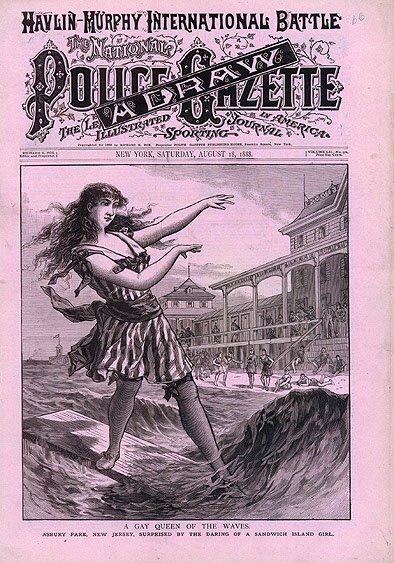
Surfing Heritage Foundation - Sandwich Island Girl 5
__________
1907 North Carolina Surfing Postcard Discovery!
East coast USA surfing history has been changed…again! Joseph “Skipper” Funderburg, author of Surfing on the Cape Fear Coast, has been conducting further research on older images in his book (www.carolinabeach.net). The December 25, 2009 discovery of the 1907 Wrightsville Beach vintage picture postcard is really going to help change the way early surfing history is written about on the American East Coast…it is Ginormous News for North Carolina. The postcard is a photographic view of a large crowd of people surf bathing on the ocean side of the Sea Shore Hotel. The 1907 postcard clearly shows a surfer on a Hawaiian styled body board!

“Courtesy, New Hanover Public Library, Robert M. Fales Collection”
The postcard illustrates the earliest image of a surfer & surfboard on Wrightsville Beach. Note surfer above the word Wrightsville. The newly discovered 1907 postcard reads, “The Sea Shore Hotel, Wrightsville Beach, NC.” The author wrote “How about a swimming lesson?” The postcard is hand dated March 24, 1907.” Based on the date, it’s pretty obvious the photo was taken during the summer of 1906 or before.
According to Steve Massengill, author of A North Carolina Postcard Album, “I am delighted to be able to support Funderburg in his effort to add to, and alter the history of surfing in the United States.” Steve Massengill continues, “Regarding the 1907 postcard, it was not uncommon for postcard manufacturers to use the same negative when printing new postcards.” “One will see the same scene on various postcards with different dates and used on different style cards – undivided back and divided back, ect.” “The companies would use different coloring and sometimes add small details and crop out others.” “The transcription of the message on the front of the postcard was published in 1907, but the photograph could date a year or more earlier.” “Funderburg’s research and statements upholds the accuracy and authenticity of the postcard.” Steve Massengill is an expert on the history of picture postcards, having worked in the field of non-textual materials as a public historian and having published several works in the field.
Prior to the days of automobile access, the location is on the old railroad line at Station Three. The Sea Shore Hotel had a magnificent view out to sea and a gently sloping beach leading to the roaring surf. The hard packed sandy beach between the island & the sea, provided the opportunity for guests to bath in the surf. Without question, the hoopla in the surf invariably crystallized around the nucleus of the oceanfront of the grand hotels, clubs and bathing establishments. We do not know exactly when surf bathers began to clutch wooden planks to their bodies and hold them before a breaking wave to hitch a ride to shore. We do know surfing in its earliest form was obviously occurring at this location. The wooden planks in the image confirm surfing was occurring on Wrightsville Beach in 1907, but more likely 1906 or before.
The importance of the site of the Sea Shore Hotel, Wrightsville Beach is indicated by the number of structures that have occupied the space. The structures on the location have been impacted by civilization, commerce, fires and hurricanes. An approximate history follows.
Undocumented shanties, shelters, tents or camps, Pre 1850 – Circa 1888
The Browns Bath House, Circa 1888
The Sea Shore Hotel built in 1892, with the addition of a steel pier built in 1910
The Ocean Terrace Hotel was built in Circa 1934
Town of Wrightsville Beach acquired the property in Circa 1954 – Circa 1962
The Blockade Runner Motor Lodge was built in 1962
The Blockade Runner Resort, 275 Waynick Boulevard, Wrightsville Beach
Picture postcards are interesting, both as art and as historic photography. An antique postcard can be a snapshot of history. A photo of surfing at the turn of the century is not only a pretty picture, but also a relic of a time past and of the scenery that has since changed greatly. Diligent surf historians, like Skipper Funderburg are among the lucky historic researchers that discover photographs of early wave riding activity on a regular basis. Celebrate and enjoy the new historic 1907 Wrightsville Beach surfing image.
For additional information surf to www.carolinabeach.net
AUTHENTICATION AND VALIDATION
According to Funderburg, Wrightsville Beach postcards have always been popular among collectors and usually command decent prices. Postcard companies would hire photographers, either local or itinerant, to take pictures of tourist spots. Then the companies would produce multiple printed cards of photos in hopes of cashing in on tourists and vacationers mailing cards back to loved ones. North Carolina postcards were not prevalent until after 1906, and postcards prior to 1912 were printed in Germany. After 1912, postcards were
printed in England and the USA, because of broken ties with Germany.
Antique or penny postcards, evoke memories of the past and provide an interesting glimpse into social, cultural and material history of the time. Historians use real photo postcards and their postmarks, to document local historical events. Vintage waterfront postcards, in particular, are prized by seaside historians. Postcard collecting is surpassed in popularity, only by coin and stamp collecting. The Golden Age of postcards is 1898 – 1913.
Funderburg’s research & postcard work is validated and authenticated by North Carolina Division of History & Archives, Raleigh, North Carolina.
POSTCARD IMAGE CITATION
“Courtesy, New Hanover Public Library, Robert M. Fales Collection”
__________
Impact on the Surf World
American East Coast surfing history has been changed. Huge news for North Carolina and the United States Atlantic Seaboard! Funderburg has proved what many global surf historians have only conjectured…that surfing on the American East Coast was taking place in isolated pockets prior to Duke Kahanamoku’s surfing demonstrations in 1912 & 1916. On May 8, 2009, professional surf historian, Malcolm Gault–Williams, author of Legendary Surfers Volume Two published, “Impacts On The Surf World – In his research for his book, Surfing on the Cape Fear Coast, longtime North Carolina surfer Skipper Funderburg came across several historic postcards from Wrightsville Beach, North Carolina’s beach scene in the first two decades of the Twentieth Century…In the postcards young boys can be seen with Hawaiian style bodyboards. That is, the plan shapes are almost identical to the ones seen in photographs of boards in Hawaii at the turn of the millennium. For surfing, this is quite a historical find, because for many decades it was assumed that Duke Kahanamoku was the first surfer on the east coast, essentially bringing board surfing to the Right Coast from California and Hawaii. The unearthed postcards definitely document surfing (albeit prone surfing or body boarding) on the East Coast prior to Duke’s bodyboarding before the 1912 Summer Olympics (Stockholm, Sweden, late June to late July), on Long Island, New York, and his board surfing at Atlantic City, New Jersey, after the 1912 Olympics.”
According to an endorsement by one of surfing’s foremost scholars, Matt Warshaw, San Francisco, California, “Funderburg’s achievements, surf book and image discoveries are going to be very useful in my encyclopedia’s new entries on North Carolina…I am currently editing the new edition of The Encyclopedia of Surfing.” Matt Warshaw is the former editor of Surfer Magazine and author of several books on surfing. Another avid supporter, Joel T. Smith, Film and Television, San Clemente, California quoted, “Global surf historians are surprised and refreshed by Funderburg’s validated research, they had conjectured the pre Duke finds would come somewhere between Marblehead, Massachusetts and Virginia Beach, Virginia.” “Funderburg’s untiring devotion to surfing has illuminated North Carolina’s earliest surfing days and proudly elevated it to the world stage.” It is cool we have been able to find an image showing North Carolina surfing that early!
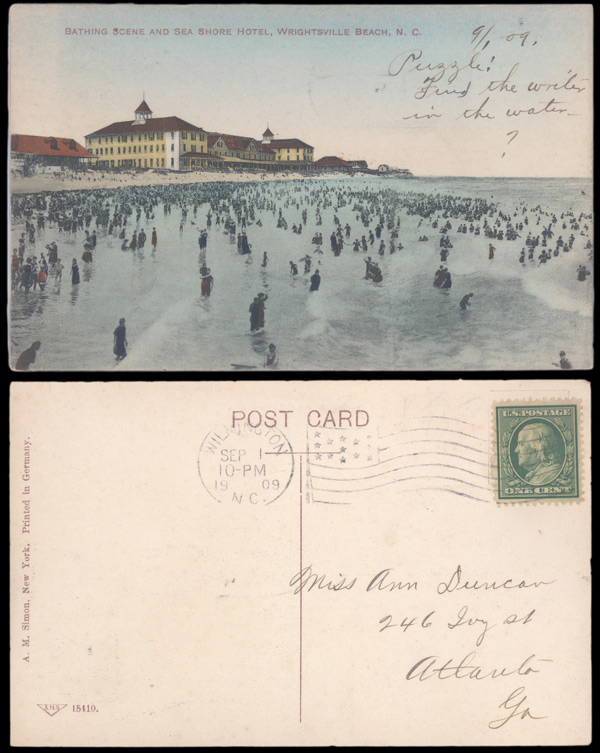
Courtesy: Peter Fritzler, Cape Fear Surfing Archive, UNCW Randall Library
According to Kim Cumber, Non-Textual Archivist, North Carolina Division of History and Archives, “The discovery is significant to the surfing community and the fact that the Wrightsville Beach postcards can be dated, and definitely pre-1909 & pre 1912 does mean that American East Coast surfing took place on the North Carolina coast prior to the advent of the sport in New York, New Jersey and Sweden.” “Quite a discovery and verifiable reasoning!” “He has done an honorable job and for that he should be commended.” Funderburg’s research & postcard work was validated and authenticated by the North Carolina Division of History & Archives, Raleigh, NC.
Funderburg continues to spotlight a variety of gems and personalities from the Carolina coast’s earliest days. A few topics of interest are - Wrightsville Beach history and culture; The art of lifeguard protection and surfing, during the first half of the 20th century; Impacts in the surf world by Carolina surf mastermind, Alexander Hume Ford (1868 – 1945); The search for the illusive 19th century Carolina image of a surfboard or record of surfing pre -1880…
The Dog can hunt!
May 12, 2009
back to Skipper's page |


